

Search "free static website generator" and you'll get a pile of listicles that were clearly written years ago and just re-dated. Half of them still push tools that haven't shipped anything meaningful in a long time.
I run Fylo.Host, a static hosting platform, so what people build their sites with matters to me every day. This week I sat down and checked every generator in this post myself: the latest version, when it actually shipped, who owns it now, and whether I'd start a new site on it today.
Short version: the free tools are better than ever, a couple of big names quietly changed hands, and for small sites you might not need a generator at all anymore.
What "free static website generator" actually means
A static site generator (SSG) takes your content, usually Markdown files plus a few templates, and turns it into plain HTML, CSS and JavaScript files. No database. No PHP. No server code running when someone visits. You end up with a folder of files you can put on any host.
All the work happens once, at build time. Visitors only ever download finished files, which is why static sites are so fast and so hard to hack.
The "free" part is real. Every serious generator in this post is open source and costs nothing to use. What you pay with is time: installing Node, Go, Ruby or Python, learning a template language, and running a build every time you change something.
In 2026 there's a second meaning too. A lot of people now type "make me a website for my bakery" into Claude or ChatGPT and get back a working HTML page. That's a static website generator as well, just one you talk to. I'll cover both.
The numbers right now
I pulled versions and release dates straight from the npm registry, PyPI, RubyGems and GitHub releases while writing this. This is the table I wish every "best of" list had:
| Generator | Written in | Latest version | Released | My read |
|---|---|---|---|---|
| Astro | JavaScript | 7.4.7 | 5 Nov 2026 | Very active, team now at Cloudflare |
| Hugo | Go | 0.169.0 | 27 Oct 2026 | Very active |
| Eleventy | JavaScript | 3.1.8 | 3 Nov 2026 | Active, rebranding to Build Awesome |
| Docusaurus | JavaScript (React) | 3.10.2 | 10 Jul 2026 | Active, docs-focused |
| Hexo | JavaScript | 8.1.2 | 6 May 2026 | Active, blog-focused |
| Pelican | Python | 4.12.0 | 20 Apr 2026 | Active, small community |
| Jekyll | Ruby | 4.4.1 | 29 Jan 2025 | No release in about 21 months |
| Gatsby | JavaScript (React) | 5.16.1 | 10 Feb 2026 | Maintenance mode |
| MkDocs | Python | 1.6.1 | 30 Aug 2024 | No release in over two years |
A quiet release history doesn't mean a tool is broken. It does mean bugs and new browser or Node changes are on you, and sooner or later you'll be migrating off it.
Now the usage side. According to Wmtips, static site generators show up on about 0.6% of all websites. Among sites that use one, Astro leads with 25.5%, followed by Gatsby at 24.5% and Hugo at 22.1%.
That Gatsby number surprised me at first, then it made sense. It's mostly legacy. Thousands of sites built between 2019 and 2022 are still running on it, even though almost nothing new is being shipped. Usage share tells you what people built then. Release activity tells you what's safe to build on now.
The free generators actually worth using
1. Astro: the best all-rounder for most new sites
Astro had a big year. In January 2026 Cloudflare acquired the team behind it, and both sides promised Astro stays open source and works on any host, not just Cloudflare. Astro 6 landed in March. Then Astro 7 shipped on 22 June 2026 with a compiler rewritten in Rust and Vite 8 under the hood.
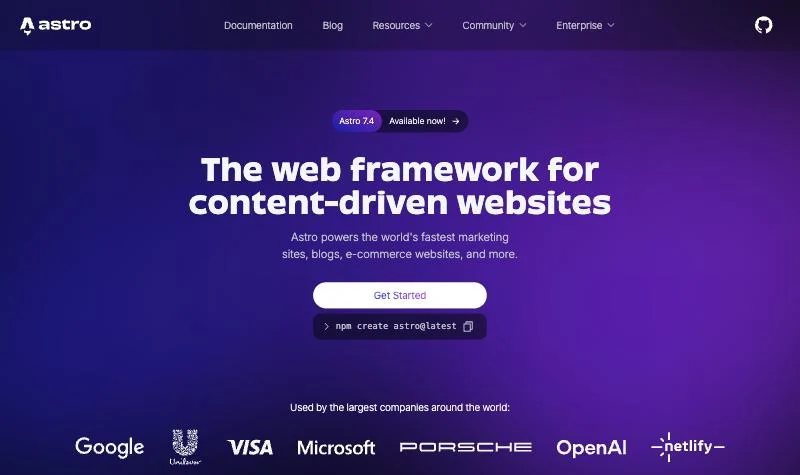
The astro.build homepage. Note the “Astro 7.4, available now” badge: this project ships fast.
The speed jump is not marketing fluff. Astro's own benchmarks show builds 15 to 61% faster, and their own website went from 62.7 seconds to 24.2 seconds to build. Astro 7 also added things specifically for AI coding agents, like a background dev server and machine-readable JSON logs. If you build with Claude Code or Cursor, that's genuinely useful.
The smallest site got the biggest percentage cut, while the biggest site saved the most actual time: over two minutes per build on Cloudflare's 8,431-page docs.
Why I like it: pages ship as plain HTML with zero JavaScript unless you ask for it, which is exactly what you want for Core Web Vitals and SEO.
The catch: two major versions in about four months. If you hate upgrade chores, pin your version. You also need Node 22 or newer.
Best for: blogs, marketing sites, portfolios, docs (via its Starlight theme).
2. Hugo: the fastest, with zero dependencies
Hugo is a single binary written in Go. No node_modules folder, no package hell. Download it, run it, done. It's still shipping constantly; v0.169.0 came out on 27 October 2026.
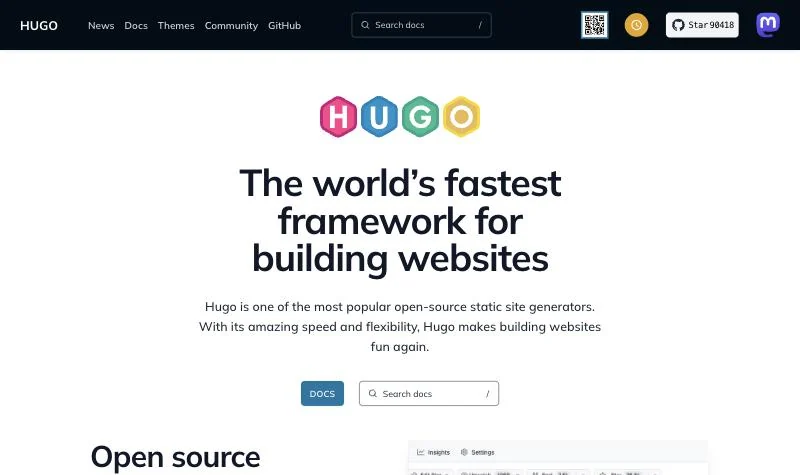
gohugo.io calls itself “the world’s fastest framework for building websites”. The GitHub button shows over 90,000 stars.
One thing worth knowing: Hugo v0.165.0 upgraded to a newer Go version to patch two XSS vulnerabilities in Go's HTML templating. If your Hugo install is a year old, update it.
The catch: Go templates are not friendly. The first week feels like reading assembly. After that it's fine.
Best for: big sites with hundreds or thousands of pages, and anyone tired of JavaScript tooling.
3. Eleventy (11ty): the simplest for people who like HTML
Eleventy is the "no magic" option. It takes your files, applies templates, writes HTML. Nothing forced on the browser side.
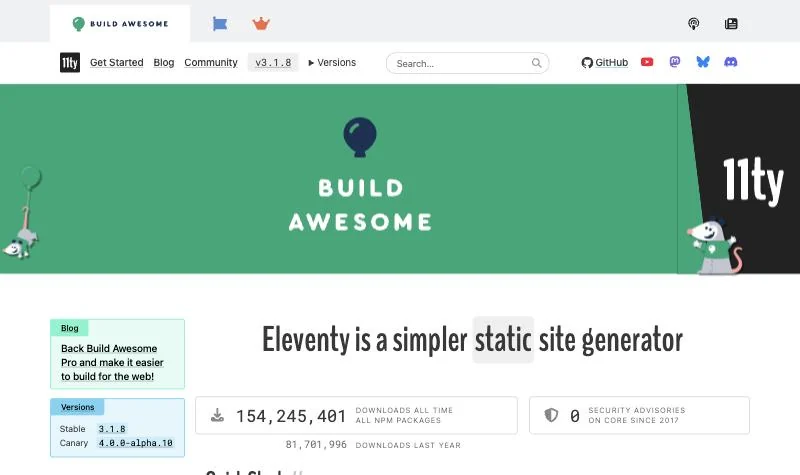
11ty.dev today: the Build Awesome banner on top, version 3.1.8 in the nav, and a 4.0 alpha in the canary channel.
There was drama this year. Font Awesome bought Eleventy in September 2024, and in March 2026 announced it would be renamed "Build Awesome", with a paid Pro tier funded by a Kickstarter. The community pushed back hard and that first campaign was pulled within days. It relaunched in April, and today the 11ty.dev homepage carries the Build Awesome branding. The team has promised the core will always stay free and open source.
What matters for you: the package still ships as @11ty/eleventy, the latest stable is 3.1.8, and version 4 is already in alpha. The project's npm packages have been downloaded more than 154 million times, nearly 82 million of those in the last year alone, so it's very much alive. Just expect to see the Build Awesome name more and more.
Best for: simple blogs and sites where you want to understand every line of output.
4. Jekyll: fine if you're already on GitHub Pages
Jekyll is the old reliable, and it's still the default on GitHub Pages. But the last release was 4.4.1 on 29 January 2025, and installing Ruby on Windows is still a small adventure.
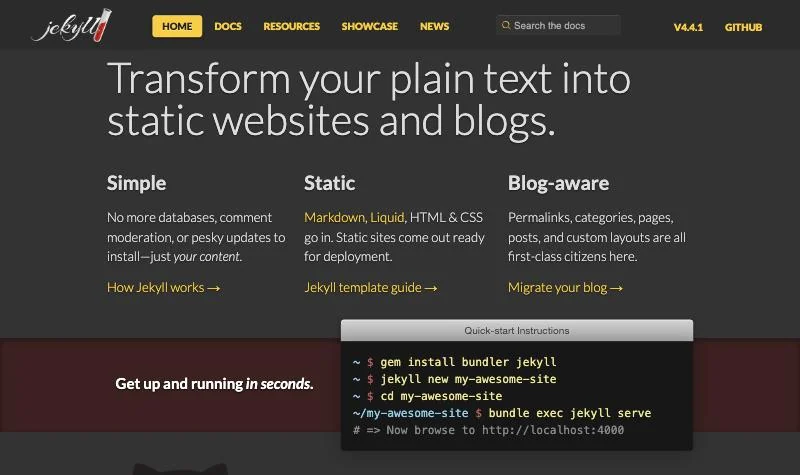
jekyllrb.com still shows v4.4.1 in the nav, the version from January 2025.
If you already have a Jekyll site, keep it. It isn't broken. I just wouldn't start a new project on it in 2026.
Best for: existing GitHub Pages sites.
5. Docusaurus: when you're writing documentation
Built by Meta, Docusaurus 3.10.2 shipped in July 2026. You get versioned docs, sidebar navigation and search out of the box. It's React-based, so it's heavier than Hugo or Eleventy, but for product docs it saves days.

docusaurus.io, with the 3.10 release front and centre.
Best for: developer docs and knowledge bases.
The one I'd skip for a new site: Gatsby
Gatsby was the hot thing in 2019. Netlify bought it in 2023, and since then it has been in what most people politely call maintenance mode. The latest release is 5.16.1 from 10 February 2026, a bug fix, and the npm registry still shows that as the newest version today, nine months later.

Tellingly, gatsbyjs.com now leads with “Migrate to Netlify today” instead of the framework itself.
If you have a Gatsby site that works, there's no emergency. But don't start anything new on it. Astro is the natural move for content sites, and the migration is mostly copying Markdown files over.
The new kind of generator: just ask an AI
Honest take: for a one-page or five-page site, you may not need any of the tools above.
A portfolio, a landing page for a side project, a wedding invite, a restaurant menu. Ask Claude, ChatGPT or Gemini for "a single HTML file with inline CSS for X", tweak it in the chat, and you have a working static site in ten minutes. No install, no build step, no terminal.
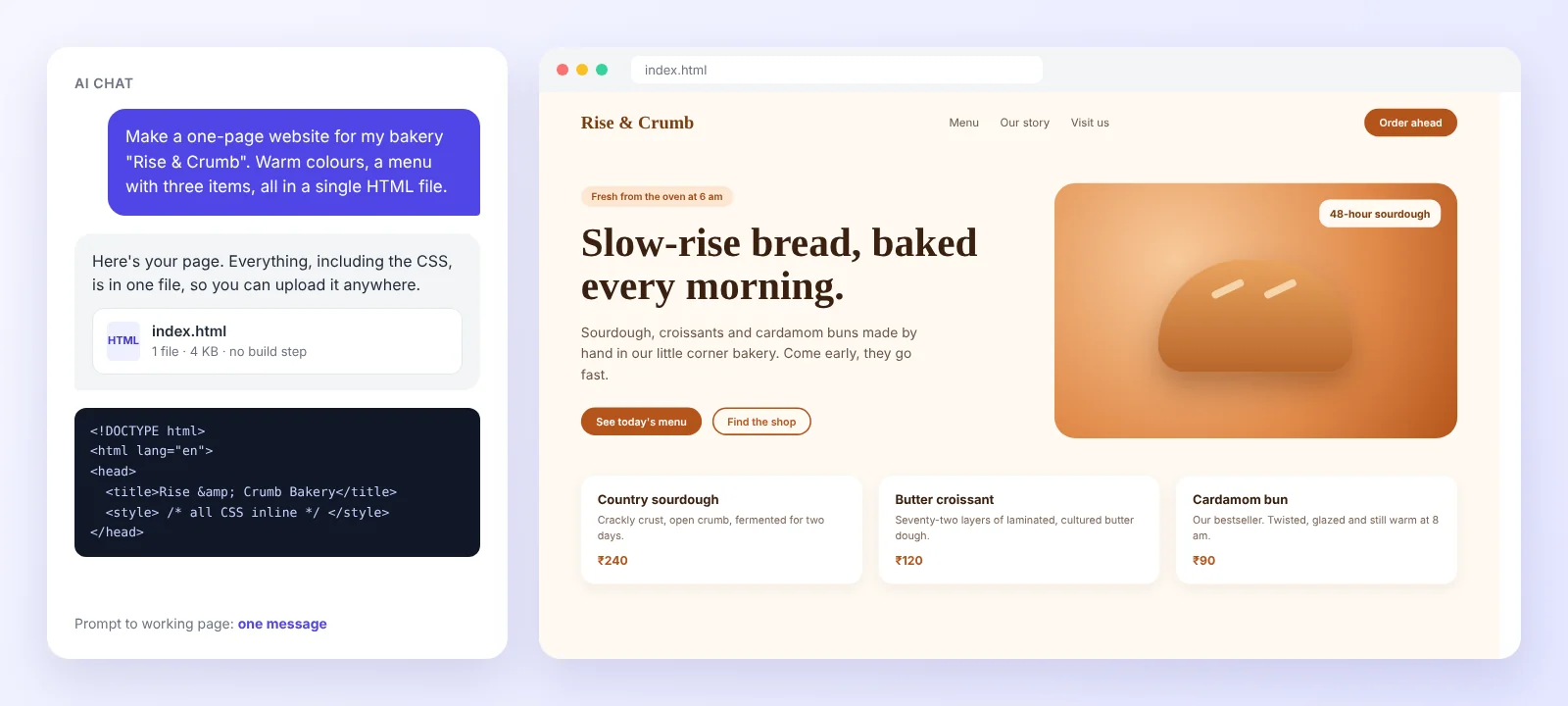
One prompt, one HTML file, no build step. I made this example bakery page with a single request to an AI.
Where it falls apart:
- No templates. Change the menu on page 12 and you're editing 12 files by hand.
- No real blog workflow. Writing post number 30 in a chat window gets old fast.
- SEO is on you. Sitemaps, meta tags, schema markup, alt text. The AI will add some if you ask, but nobody keeps it consistent across pages.
- You still need somewhere to put it. An HTML file on your desktop isn't a website.
My rule of thumb: 1 to 5 pages, use AI or hand-written HTML. A blog or anything that will grow past 20 pages, use a real generator, or a host that has a blog built in.
How to choose in 60 seconds
- Never opened a terminal? Let an AI write the HTML, or use a host with a built-in editor and blog.
- Blog or marketing site, and npm doesn't scare you? Astro.
- Thousands of pages, or you hate dependencies? Hugo.
- You like plain HTML and want zero magic? Eleventy.
- Writing documentation? Docusaurus, or Astro with Starlight.
- Already running Jekyll on GitHub Pages? Stay put. It works.
- Thinking about Gatsby? Don't.
Generating is free. Hosting is the real decision.
Every generator above ends the same way: a folder called dist, public or _site full of HTML files. That folder needs a home, and this is where people get stuck.
GitHub Pages, Cloudflare Pages and Netlify all have free tiers, and for a hobby project they're fine. What tends to bite later is everything around the files: build minutes, bandwidth limits, no contact forms, no analytics, and SEO work you have to wire up yourself page by page.
That gap is exactly why I built Fylo.Host. It's complete static site hosting with a built-in blog, auto-SEO and auto-speed:
- Upload the output folder or a ZIP. Whatever your generator spits out, drag it in and it's live, served from Cloudflare's edge in 330+ cities.
- A blog that's already there. If the only reason you wanted a generator was to write posts, you can skip it. Write and publish from the same dashboard.
- SEO handled for you. Sitemaps, schema markup, llms.txt and robots.txt are generated automatically, and a broken-link checker watches your pages.
- Speed handled for you. Image, CSS and JavaScript optimizations are toggles, not weekend projects.
- Forms included, so your static contact page actually works.
To be upfront: You can start with a free trial and see if it fits before paying anything.
Frequently asked questions
Is a static website generator really free?
Yes. Astro, Hugo, Eleventy, Jekyll, Docusaurus, Hexo and Pelican are all open source and free to use, even commercially. The only costs are your time and wherever you host the output.
What's the easiest free static site generator for beginners?
If you can write a little HTML, Eleventy. If you're comfortable with npm, Astro has the best starter templates. If you don't code at all, ask an AI for the HTML and skip the generator.
Are static websites good for SEO?
Very good. They load fast and search engines read plain HTML easily. But fast isn't the same as optimized. You still need a sitemap, titles, meta descriptions and schema markup, either by hand, through plugins, or from a host that generates them.
Can I turn a WordPress site into a static site?
Yes. Plugins like Simply Static export your WordPress pages as HTML files that you can host anywhere. You lose comments and dynamic features, but the site gets much faster and there's nothing left to hack.
Which generator is fastest?
For raw build speed on large sites, Hugo is still the one to beat. Astro 7 closed a lot of the gap with its Rust compiler. For the visitor, all of them produce fast pages. What decides real-world speed is mostly your hosting and how heavy your images are.
Using a generator I didn't cover, or think I got one wrong? Tell me at ravi@fylo.host.
— Ravi, founder of Fylo.Host
Sources
- Version numbers and release dates were checked on the npm registry, PyPI, RubyGems and GitHub releases on 9 Nov 2026. Homepage screenshots were taken from each project's official site the same week.
- Static site generator market share, Wmtips
- Cloudflare acquires Astro, Business Wire (16 Jan 2026)
- Astro 6.0 release post
- Astro 7.0 release post
- Astro 7 build speed coverage, InfoQ
- Hugo releases, GitHub
- Eleventy is now Build Awesome, Zach Leatherman
- Font Awesome pauses the first Kickstarter, Disassociated
- 11ty.dev homepage (Build Awesome Pro campaign, download counts)
- Jekyll 4.4.0 release notes
- Gatsby maintenance status, Vardot
- astro, @11ty/eleventy, gatsby, @docusaurus/core, hexo on npm; pelican, mkdocs on PyPI